Monday, November 4, 2013

Enzyme Catalysis Lab

Purpose: An enzyme is a protein which speeds up the reaction of a certain biological process. During this lab, the function of an enzyme was tested. Inhibition was also tested. An inhibitor slows down or stops a reaction completely.

Introduction: An enzyme is used to speed up a chemical reaction. This is called a catalyst. a catalyst is needed to raise the activation energy of a material. this material is called the substrate. the substrate will bind to the enzyme in order to activate the reaction and produce the final product. After the product is made the enzyme is not just thrown away or used up, it can be used over and over again, as long as there is substrate for it to act upon. But there are ways that the enzyme can break and fall apart, this is called Denaturing. Once an enzyme becomes denatured it cannot do its job and is therefore useless.  Two very common ways that enzymes become denatured is by a change in ph or a change in temperature. Enzymes like to live in very specific zones. they don't like it too hot or to cold. and if they are out of their comfort zone they will not work as well. and if they get too far out of their comfort zone they will not work at all. This is how enzymes get denatured. Enzymes can only work on a set number of substrates at a time. So if we were to say that one enzyme can only process one substrate every 3 minutes, then after 9 minutes 3 substrates would be made into products. And even if we have 100 substrates to choose from, after 9 minutes only 3 will be made into products. But if we were to add more enzymes into the mix more products can be made. So if there were 2 enzymes after 9 minutes they would have made 6 products, and so on and so forth. I think you get the idea.  Enzymes can only go so fast, and they can only continue  to work as long as there is substrate for them to work with.


Methods: In order to test the ability of an enzyme and an inhibitor, 7 cups were filled with H2O2. Each of these cups had a certain time range the catalase had to be left in there for, ranging from 10 seconds to 360. Catalase in the form of yeast was added in order to start the reaction, and sulfuric acid was added in order to stop the reaction. The solution was then titrated with potassium permanganate until the solution had turned a purple-brown. We knew the solution had ran out of H2O2 once the solution remained a solid purple-brown color.  


Data:


Graphs:


Discussion:
when we titrated for the baseline we found that there was consistently a 3mL reading for the baseline. Then when we found the percent that was spontaneously decomposed in 24 hours of sitting out, we found that there was a  43% difference in the amount that was decomposed. Then when we  titrated the solutions we noticed some interesting things. For instance, the amount of KMno4 that was consumed declined until the time before reaction was 90 sec; then once the tione hit 90 sec the amount consumed stayed the same for the rest of the experiment. this shows that after a min and a half there was no other effect on the amount of KMno4  that would be consumed. Then when we looked at the amount of H2O2 that was used it increased until 90 seconds and then it also leveled off. So It would seem that after 90 seconds the total production of the enzymes will level off.


Conclusion: The rate at which a 1.5% of H2O2 solution decomposes is .22ml of H2O2 per second. After 10 seconds, 2.2ml of the H2O2 was used. A maximum of 2.5 ml of H202 was used during the reaction. After 90 seconds, the H2O2 was no longer used up in the reaction.

Monday, October 21, 2013

Diffusion and Osmosis Lab

Diffusion and Osmosis Lab

Purpose:

1A) In this experiment diffusion of small molecules through dialysis tubing was tested to prove a selectively permeable membrane. The dependent variable consisted of the color and change in starch. The independent variable was the IKI which did not change.
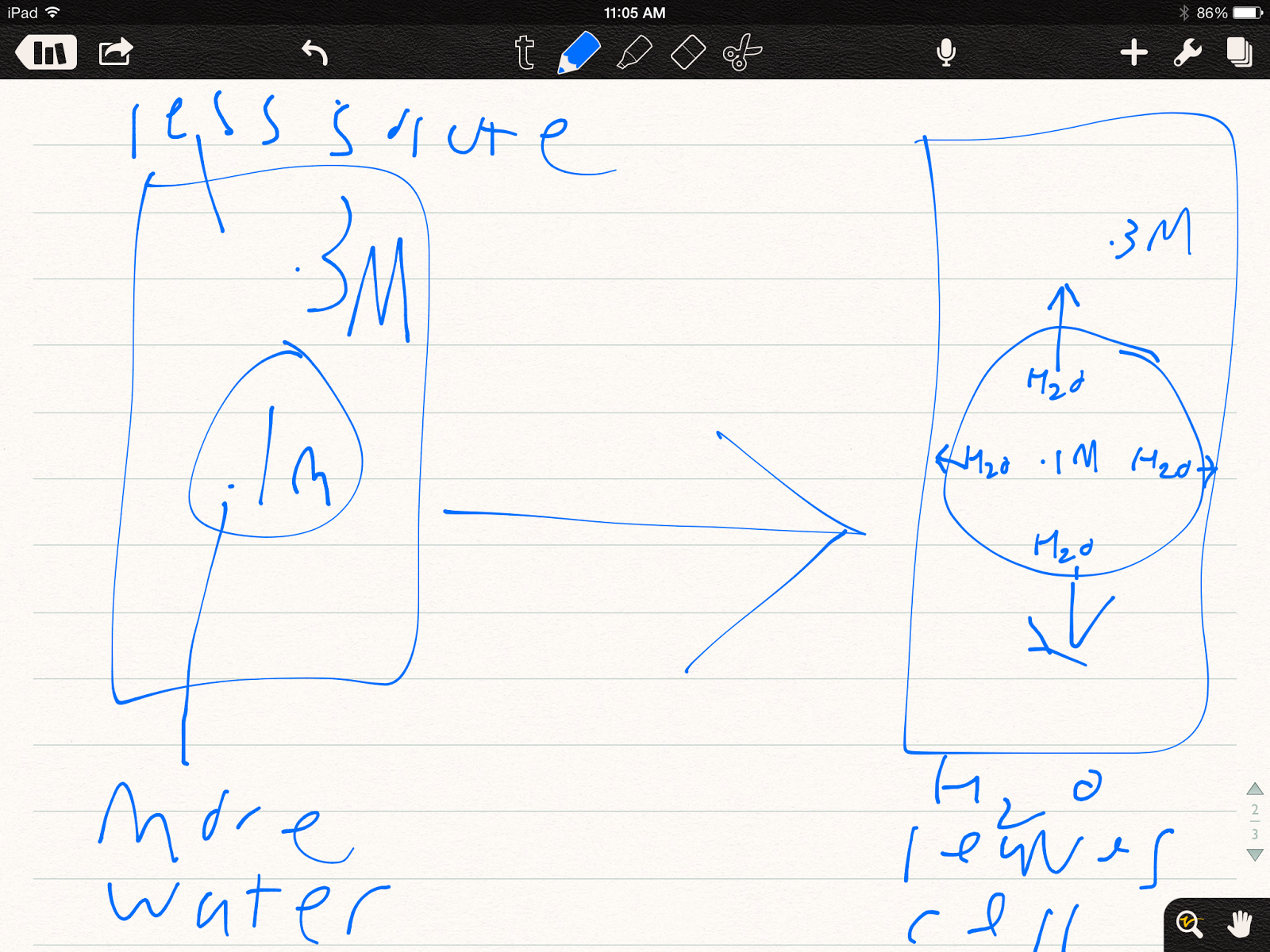
1B) Exercise B shows the relationship between the movement of water through a cell membrane is related to the concentration of a solute. We were trying to see if the differing amount of a solute located inside the cell would change the amount of water that diffused through the cell through osmosis
1C) The purpose of this lab was to determine the water potential of potato cells. This was to be determined by placing potato cores in solutions with different molar concentrations of sucrose and recording the % change in mass of the cores. By finding the molar concentration of sucrose when there is a 0% change in mass, we could then find the molar concentration of the potato cores and then determine its water potential.
1E) The purpose of this lab was to examine the effects that a high concentrated solution would have on diffusion and the cell of an onion. This would be done by placing the onion in
Introduction:
1A)Different cells may have different membranes which control what comes in and what leaves the cell. In this experiment, this was exactly what was tested. Selectively permeability is extremely important to a cell. A cell cannot let anything and everything in. The membrane only allows certain molecules of a certain size in and out.
1B) Two solutions that have the same concentration of solute will be iso tonic. So water will be able to move freely through a selectively permeable membrane but the change in the amount of water in both solutions will stay the same. However if these two solutions have different concentrations of a solute (one being less and one being greater) the change in the amount of water on either side will be different in order to balance out the solution.

 Hypertonic


1C) Water potential is a measurement of the tendency of water to move from one place to another. Water potential is equal to the pressure potential added to the solute potential. Solute potential is the effect of solutes on overall water potential. It is always a negative value and it is inversely related to water potential. An increase in pressure potential also increases the water potential. Water will always move from an area of higher water potential to an area of lower water potential. When the water potential of the cell and the water potential of the liquid are the same, dynamic equilibrium has been reached and there will be no net movement of water. When a cell is placed in an iso tonic solution, the solute concentration of the cell and the solution are equal and there is no net water movement across the plasma membrane. When a cell is placed in a hyper tonic solution, the solute concentration is greater than that inside the cell and the cell loses water. When a cell is placed in a hypo tonic solution, the solution con creation is greater than that inside the cell and the cell gains water.
1E: When placed in a hypertonic solution, the solute concetration is greater than that inside the cell and the cell loses water. When placed in a hypotonic solution, the solute concetration is less than that inside the cell and the cell gains water. When placed in an isotonic solution, the solute concetration is the same as that inside the cell, and there is no net water movement across the plasma membrane. When placed in a hypertonic solution, the cell undergoes plasmolysis and the cytoplasm shrinks and the cellular membrane pulls away from the cell wall.
Methods:

A) In order to stimulate and explain a cells selectively permeable membrane, a piece of dialysis tubing was cut to size and filled With 15% glucose and 1% starch solution. This dialysis tube, now a baggie, was dropped in a cup of IKI. We left the dialysis tube in with the iodine for approximately 30minutes. The bag was then removed and we began observing changes.
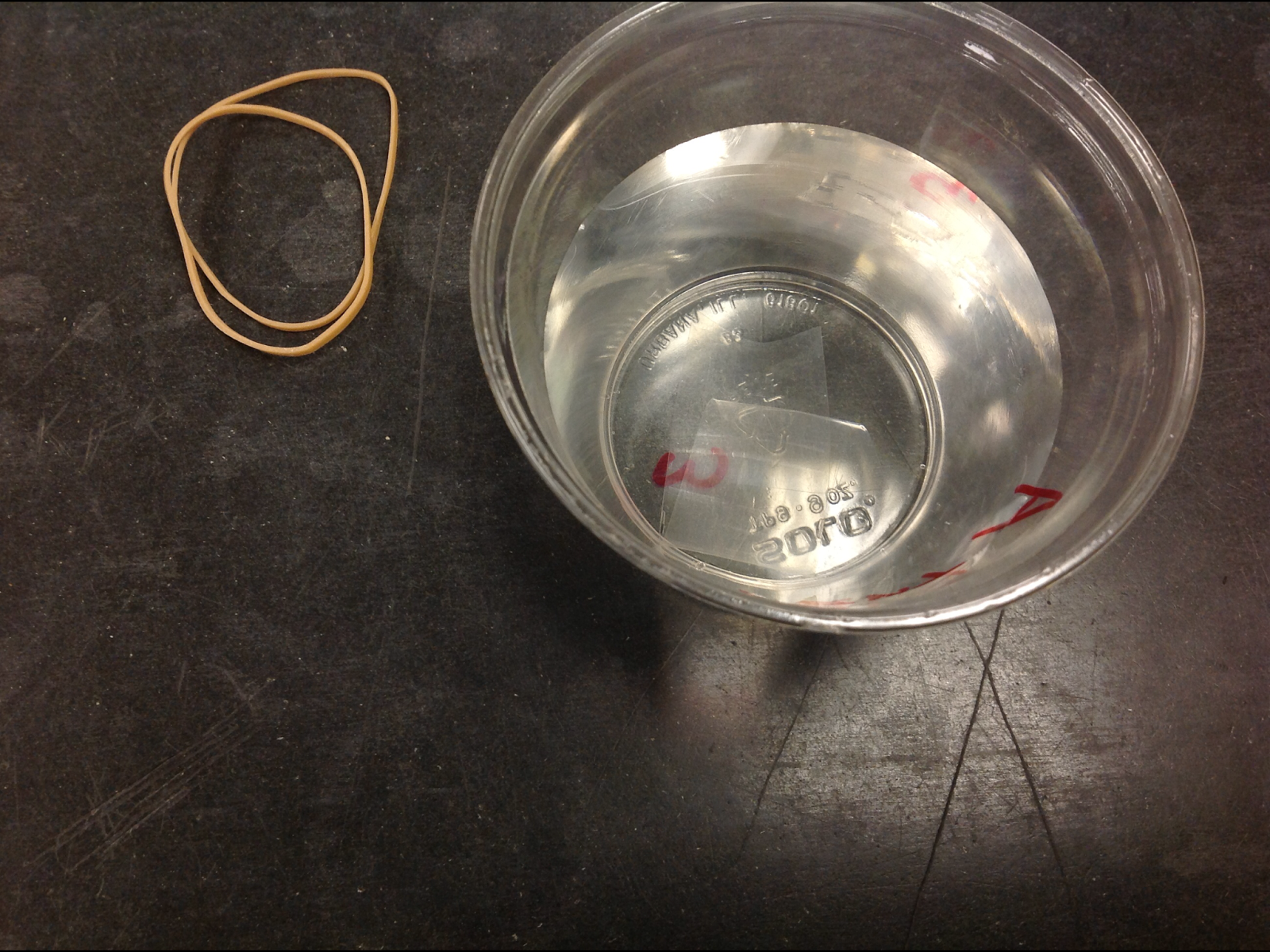
B)we filled six dialysis bags with differing amounts of sucrose concentration. These will be our cells with either hypo, Iso, or hyper tonic cells. We then weighed them in order to have their original weight to compare once the test was over. The "cells". We're then submerged inside a cup of water for thirty minutes. After the thirty minutes, the "cells" were weighed again in order to see if there was any difference in the weight. If there was a higher weight that would mean water went into the cell, and if there was a lower weight that would mean that water came out of the cell.
C) For this experiment we cut 24 potato cores and separated them into groups of 4. We weighed each group and recorded it on the date table. Then we placed each group into a cup that contained either 0.0M distilled water, 0.2M sucrose, 0.4M sucrose, 0.6M sucrose, 0.8M sucrose, or 1M sucrose. We then covered the cups and let them sit overnight. The next day we took out the potato cores, blotted them, and then weighed each group and recorded the new weight of the cores on the data table. Then we found the change in mass of the potato cores in each liquid and calculated the % change in mass.
1E) For this lab we observed a piece of an onion under a microscope.  First we put 15% NaCl and then freshwater on the onion and observed the effects of it on the onion cell.
Data:

1A

1B


1C

Graphs

1C


Discussion:

1A) Starting off, the baggie contained 15% glucose and 1% starch and the solution was colorless. The baggie was then added to a solution of water and IKI which was a dark yellow color. After sitting for 30minutes, the solution inside the baggie was a dark blue color and the solution in the cup was still a dark yellow. This clearly explains concept of a semi permeable membrane. As we predicted, the starch in the baggie would react with the IKI as in passed through the semi permeable membrane of the baggie. To prove that it was only the starch that reacted to the IKI, we tested and realized that both at the beginning and at the end of the experiment the glucose remained the same.  This was done with glucose testing strips. At the beginning the glucose tested at 15 inside the baggie and 30 on the outside. At the end, we dipped the glucose testing strip once again and it tested at the same as in the beginning. The results matched our predictions, as we said glucose molecules are too big to get through the selectively permeable membrane, but since the starch molecules are a lot smaller they would make it through
1B) After we pulled the bags out of the water and weighed them we noticed that the bag with just distiller water weighed the same as when we put it in originally. This was expected because it is just water , so no extra water needed to be added or removed to create a balance inside the cell. But then as the molar it you'd sucrose inside the cell increased so did the % change in mass. The more concentration of sucrose inside the bag the more amount of water went into the cell. The amount of water that was let in steadily increased as the molar it's went up. Starting with only a 2% increase in mass at .2M of sucrose, alluded way to a 10% mass increase in the 1.0M of sucrose. This experiment clearly showed how a hypo tonic cell will tend to take in more water in order to equalize itself with the concentration on the outside. The experiment did exactly what we thought it would, we thought that the higher the molarity, the more water the cell would take in, in order to equalize the outside.

1C) As the potato cores were placed in solutions with higher molar concentrations of sucrose, the % change in mass of the cores became more negative. When the potato cores were placed in 0.0M distilled water or 0.2M sucrose, the potato cores' mass increased and the % change in mass was positive. This means that the cores were placed in a hypo tonic solution and they gained water and mass. When the cores were placed in .4M sucrose, .6M sucrose, .8M sucrose, or 1M sucrose, the potato cores' mass decreased and the % change in mass was negative. This was because the cores were in a hyper tonic solution and they lost water and mass. Looking at the graph of the data, you can see that somewhere between .2M sucrose and .4M sucrose, the % change in mass would've been 0% and the molar concentration of sucrose would equal the molar concentration of the potato cores. This means that water potential of the water with that molar concentration would equal the water potential of the potato tissue. This concentration is approximately .23M sucrose. An inconsistency in the data is at .8M sucrose. The % change in mass should've followed the trend and been more than the % change in mass of .6M sucrose but instead it was less. A better way to improve results and get more accurate results would be to have a way to dry all the potato cores the same way so that some wouldn't lose more water than others.
1E) When the 15% NaCl was added to the onion, the cell was in a hypertonic solution and the cell underwent plasmolysis and lost water. However when freshwater was added to the onion, it was in a hypotonic solution and the onion cell gained water.


Conclusion:

1A) Selectively permeable membranes are extremely important in a cells life. They play a huge role in keeping the cell safe and satisfied.  This was proven in this experiment after the starch in the dialysis baggie reacted with the IKI on the outside, which shows us how the difference in size of starch and glucose played an important role in getting through the selectively permeable membrane.  
1B) All in all this experiment showed that an iso tonic solution will cause a cell to take in no extra water, but a hypo tonic solution will cause the cell to take on water in order for the inside and outside of the cell to reach an equilibrium.
1C) The molar concentration of sucrose at which its water potential is equal to the water potential of the potato tissue is approximately .23M sucrose. At this concetration, the solution has a water potential of -5.29 bars (.1M = -2.3 bars). Although the solute concetration of the potato tissue and the solution aren't equal, the pressure potential of the potato cells equals out the solute potential of the potato so that both water potentials are equal. Since there is no net movement of water at this concetration, this means that the water potential of the potato cells is equal to the water potential of the liquid. Therefore, the potato cores have a water potential of -5.29 bars.

1E) When the NaCl was placed on the onion cell it experienced plasmolysis. It then gained back water when it was placed in freshwater.

Monday, September 30, 2013

Mihais Reflection

The trip to the Glacial Park was absolutely great. It made me appreciate and realize just how important we are both in good and bad ways when it comes to affecting the environment. When we first arrived, we were brought outside in a fenced in area on a hill out looking the park.
It gave me a sense of just how small we really are compared to the environment around us and just how much we affect it. Our guide began explaining to us what their job is. He explained just how important speeding up the process of restoration is and just how long it would take. The park is roughly 3500 acres of trees, brush, bogs and lakes. When walking through, I realized the beauty of this place. It was quiet, serene and seemed to be full of life. We all walked in single file lines and split into two groups. Splitting into these two groups allowed us to maximize our time and do more work. The group I was in first started with planting/scattering seeds and watering trees which had already been planted.  After we had planted scattered and water we moved on to removing invasive species of brush and grasses. Working hard as a group we were able to remove a lot of these invasive species. What shocked me was that we worked for about an hour or so and were only able to do so much. We were also about 30 students who were constantly working, and we barely removed anything. It really just once again showed how little we are compared to our environments. This field trip was definitely necessary in showing what restoring our environment is about. Seeing what the goals are for glacial park and what the team working there had accomplished is great. It showed us just how much more can be accomplished when trying to restore an environment back to its normal state. We were explained to how gophers had started migrating back since the restoration started. This is a great sign as ecologists know that what they've been doing is right. As humans, we have built and expanded and destroyed what was we once had. Now we realize just how important our environment is to us and our survival. Restoration ecology is extremely important and it will save us, there are no negative sides to it. 


Sunday, September 29, 2013

Alfredo Salomon

During our field trip to Glacial Park, we were able to get up close with nature and observe and interact with the many plants that grow there. One of these plants was the hazelnut tree. By planting and watering these trees, we were able to do some restoration and help the environment back to its natural state. This would be beneficial to the soil and also to any animals that lived nearby. Planting these trees is our way of giving back to the Earth and helping it restore itself. Also, the clearing and removal of invasive species was another way that we were able to take part in restoration ecology. The removal of these invasive species allows new plants and trees to grow in their place and benefit other plants and animals nearby. Overall,I think that restoration ecology is very necessary, as a majority of the Earth's damage is caused by humans, and I think it is now our responsibility to help speed up the recovery of these degraded ecosystems. The planting of trees and clearing of harmful plants is just one of many ways that we can help the environment return to its normal state and by doing this, we can speed up a process that would otherwise take a very long time. Displaying IMG_0932.JPG

Displaying IMG_0044.JPG

Restoration Ecology

On the restoration field trip we were able to experience how much our local environment is tainted by invasive species. And the work that needs to be done in order to bring the environment back to what it once was. We removed foreign invasive species that were in a sense choking out the naturally occurring original plants. We also worked to replant and nurture oak and hazelnut trees because they were the plants that should be there, instead of the ash trees and brush.
 

Here is one of the local growing "Nutella trees" (hazelnut tree), we went to all of these and watered them with 2 gallons of water each. These trees were planted in a field along with other oak saplings. Another task we had was to plant acorns rebound these trees in the hope that some more trees would grow.

After we watered the trees we went over to remove the invasive species. We learned very quickly that there are tons of thorns that are ready to prick you. We hacked and chopped away at all the unwanted brush in order to free up room for the naturally occurring plants. And anything that we chopped down we put on these big burn piles. The piles will be burned later in order to keep the plants from just re growing. Also the burning helps the carbon cycle releasing all the stored carbon in the plants into the air via smoke.

I learned that we as humans have a massive impact on the enviornment around us. All the invasive plants that were there would never have gotten there if they weren't carried by us from all diffrent places. Because we came here from all over we brought all diffrent plants that pollenated and started taking over the land. When this all happens they start to kill off the naturally occurring plants which in turn slowly kill off the local wildlife because their food source is gone. This is why we have restoration, to make sure that the invasive species do not completely take over and kill off everything.

Now as I have just explained is why we have restoration ecology, but I have a sort of difficult question. What does it actually matter? Lets say that we just let these invasive species take over and all the natural plants and animals are wiped out. I guess what I am saying is "so what?" Is there any real reason other than just the moral obligation that we feel that we need to fix the damage we essentially caused?


-Eddie Graham

Friday, September 13, 2013

Acid/Base Lab

Purpose: The Acid/Bases lab was designed to show and prove how acidic or basic a mixture is. The drops of .10M HCl (acid) and the .10M NaOH (base) were the two independent variables which changed the pH of the mixtures. We were trying to find out how certain materials, such as orange juice, would react to different amount of a certain base or acid.

Introduction: Different solutions have different reactions to different acids and bases. Some solutions may have a different resistance to some acids and bases than others. This allows us to see the change in pH and the total buffer range. The buffer range shows us just how resistant the solution was to the acids/bases added. This is"

Methods- during the experiment we used the "Lab Quest 2" PH sensors to test how the PH was effected when acidic and basic solutions were added to certain materials. We measured the change in PH for every five drops of an acidic or basic solution that we added to two seperate samples of our material to be tested. We then tracked the changes in PH (rise or fall) as the basic and acidic solutions were added. The data was graphed using the Lab Quest 2 devices. The graphs will be Shown below.


Data:
pH of Water


pH of Orange Juice

pH of Gelatin


Graphs and Charts: Blue = Base    Red = Acid

pH of Water

pH of Orange Juice


pH of Gelatin
Discussion: In our experiments our tested materials were water, orange juice, and gelatin. When the water was tested the solution started out roughly as a neutral solution. As the acidic and basic drops were added the PH level was drastically changed. Within ten drops there was a six PH difference between the water with the basic solution and the acid solution. And by the end of the thirty drops there was over an eight PH difference. This shows that water is highly effected by the outside additions of things of different PH. Where in the orange juice solution it started off mostly acidic and then only varied a little. The added acidic solution made the orange juice PH lower only slightly, there was only a .25 PH difference. And in the Basic solution there was a bit of an off reading. the graph dipped quite a bit, and then slowly climbed up back to normal, and then gained only .04 PH. This shows that the orange juice had very little variance in PH, there was only a variance of .26 PH. Lastly we did the experiment with a gelatin solution. This solution started off with a mostly neutral PH. Then as the different PH of solutions were added there was a variance in the PH. Unlike the orange juice the gelatin and the water were very affected by outside additions to the solution. They both ranged greatly in variance in PH but the orange juice resisted change very well.

Conclusion: The orange juice acted as the best buffer out of the 3 solutions. Its pH resisted change, even when drops of HCl and NaOH were added to it. The water was the poorest buffer because its pH changed the most when the drops of HCl and NaOH were added to it.

Refrences: We did not really use other outside references.